Monday, December 27, 2010

Stadthuys and Christchurch


This Christ Church is the oldest functioning Protestant church in Malaysia. The construction of this began in 1741 on the centennial of the Dutch occupation and it was finally completed in 1753. Before this date, the Dutch used the old Portuguese church atop St Paul’s hill for their religious services. There were a lot of tourists in the area and lots of stalls with souvenirs and small arts and crafts such as a kaleidoscope. The things sold in the area were over priced and bargaining was difficult. There were lots of flowers and plants in the area and it added colour to the red ambience created by the 2-3 huge red buildings of Christchurch. Trishaws were also around. Many in the vicinity but those not taken with tourists were parked at the side lines, opposite the Church’s front entrance.
Stadthuys is the oldest and largest building surviving in Southeast Asia from the early Dutch colonial era. It covers 9,200 square feet (including annexes) and the building practically forms its own streetscape.

Jonker Street


This street has plenty of antiques and it is an area where prices can easily be bargained. The artifacts and relics are authentic and some date back to as far as 300 years. Each artifact/relic has its own history and mystery. This street now has a new wave of cafes and craft shops and it’s lending a cultured air of old-meets-new.
Jonker street also has great food and ice cold traditional desserts. The street is basically a stretch with lots of antique shops, souvenir shops and lesser but still quite a few food/beverage stalls.
The shop keepers are mostly approachable and easy with the prices if one were to bargain.


Kampong Keling Mosque


This Mosque is a Sumatran-style building with a three-tiered wooden roof. It was built in 1748 and the outer wall was completed in 1868. This temple is unique in that it is one of the few mosques with a pagoda instead of a minaret. Also, the interior has no dome which is different from others and very unusual. The arcade around the prayer hall is a series of Corinthian columns, reflecting the European influence.

Sri Poyyatha Temple

 This Hindu temple stands on the same street as Kampong Hulu Mosque and Cheng Hoon Teng temple. The three distinct faiths coexist and thus, stands as a testament to the religious pluralism of Melaka. The temple was also erected in 1781.
There were signs in the area but most of which were to signal directions and to label the Hindu temple. The roof and design of the temple was uniquely designed and also very distinctive in terms of the culture of Hindus and the belief.

Cheng Hoon Teng Temple


 This temple was founded in 1645 by Lee Wei King and is the oldest functioning Chinese temple in Malaysia. The main hall was built by Chan Ki Lock in 1704 and was rebuilt in 1801 by Kapitan China Chua Su Cheong. The temple was constructed by craftsmen using materials brought in from southern China. It occupies 50,000 square feet.
The area is mainly full of middle-aged, Chinese people. There are also a lot of rich culture in the design of the roof and overall architecture of the temple. The temple grounds are also very spacious and airy.

Baba & Nyonya Heritage Museum

This place we visited was about Peranakans. In Malaysia though, there are such people called the Indian ‘Baba’s. Under this, they are sub-divided into 2 types, the ‘Chitties’ who live the Malay culture and lifestyle but are true blue staunch Hindus, and the ‘Chittia’, who dress in white and are moneylenders. Some of the ‘Chittia’s are at Jonker street. ‘Chittia’s will not lend money to you if you aren’t able to provide them with property in exchange.  Peranakans also tend to have a Malay slang and are, in this day and age, mostly Christians/Catholics. Peranakans are straits born Chinese and follow the Malay culture sometimes. An example would be how it is rude to pass people things with your left hand as that hand is ‘unclean’. In the 1950s, there were a lot of Chinese Peranakans in Singapore but now, there is intermarriage.
In the Baba museum house, there was a divider that divided the female and male rooms that were side by side. It also acted as a barrier so females and males couldn’t meet/see each other before they got married through their arranged marriage. However, there were slits that allowed people from either room to peer through.  The female Peranakans of then, were very conservative.
In the olden days and in modern time as well, there are a lot of Victorian designed lamps as well as lamps which need fueling, used in Peranakan/Baba houses. Also the type of cloths they use tend to be silk embroidered which not only takes 5-6 years to stitch, but also expresses the family’s wealth. Babas wear ‘kabayas’ which are lacy and/batik and are translucent. Kabayas follow the figure of the wearer. Peranakans also tend to have marble objects around in their house.  Marble, apparently, has a soothing and cooling effect and this helps in terms of ‘cooling’ people down, especially hot tempered people in which, most Perankans are. They also have a stone grinder and pounder, one which they have to work manually. The plates that they use are differently coloured for different ceremonies and occasions. There were also no chopsticks because of their eating style(malay).
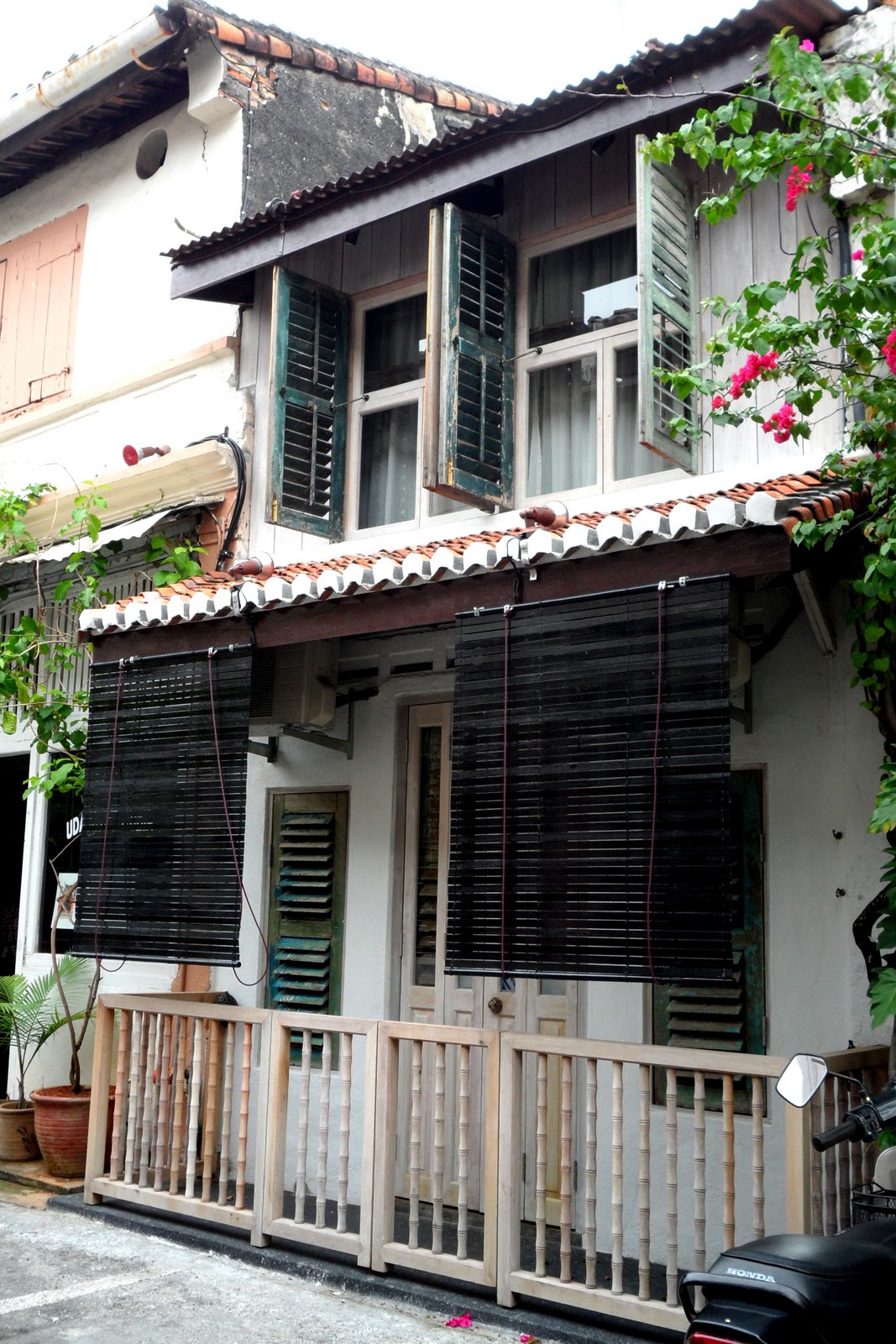
The houses of Babas tend to have a small façade but a huge interior. The small and narrow design concept.

Taman Mini Malaysia


This area we visited encompassed 13 kampong houses of traditional architecture. Each of the homes represent the architectural style of the 13 states in Malaysia and each house is filled with many different kinds of arts and crafts which depict the culture of each state. The area is rather spacious and has a sense of cultural and heritage richness.
The people in the area are middle-aged and older. Most of them are dark-skinned and wear tudongs. They are very traditional and approachable.
The objects around and inside each house, are genuine handicrafts originating from each state or county.
The area also has a park which has weekly cultural shows and traditional games. This therefore, acts as an opportunity to see all Malaysian architecture and heritage. It helps us to break away from the hustle  and bustle of urban Melaka.